

10 Facts About Climbing Ropes You (Probably) Didn’t Know
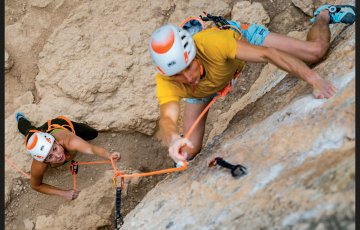
A climbing rope. For a climber, it's more than just a piece of equipment—it's a connection to a partner and a symbol of trust. We entrust our lives to it every day, but have you ever wondered what secrets and stories are hidden within its braided fibers? From brutal lab tests to revolutionary innovations, get ready for 10 interesting facts that will change the way you look at your rope.
1. The Magic of the Fall Factor: Why a 2-Meter Fall Can Be Worse Than a 10-Meter Fall?
One of the most crucial, yet often misunderstood, concepts is the fall factor. It’s not about the length of the fall, but the ratio of the fall's length to the length of active rope that absorbs it. The fall factor is calculated as: length of fall / active length of rope. The maximum theoretical value in climbing is 2 (e.g., falling 10 meters on 5 meters of rope out). A short, 2-meter fall right after leaving the belay station (with 1 meter of rope out) has a fall factor of 2, whereas a long 10-meter fall high up the wall (with 20 meters of rope out) has a fall factor of only 0.5. Thus, a short fall can be much harder on the rope and your body!
2. The Hemp Revolution: How World War II Saved Climbers
Before WWII, climbers relied on ropes made from natural fibers like manila hemp. These ropes had low strength, almost no stretch (they were static), and were extremely susceptible to moisture and rot. A leader fall was almost always fatal. Everything changed with nylon (polyamide), which was developed for military purposes (e.g., parachutes). After the war, companies like Edelrid and Mammut began experimenting with nylon, and in 1953, Edelrid created the first kernmantel rope (with a core and sheath). The modern dynamic rope was born, and climbing became incomparably safer.
3. The Heart and Soul of a Rope: The Core Provides up to 70% of the Strength
A modern dynamic rope consists of two parts: the core (kern) and the sheath (mantel). You might be surprised to learn that the colorful sheath, which protects the rope from abrasion and UV radiation, only contributes about 30% to the overall strength. The real hero is the white core, woven from thousands of thin polyamide filaments, which carries up to 70% of the load and, thanks to its construction, can absorb the energy of a fall.
4. When Half Means Everything: The Genius of the Bicolor Rope
Finding the middle of the rope, especially when rappelling on long routes, can be stressful. In the 1990s, the French company Beal introduced a revolutionary innovation—the Bicolor rope. Instead of a simple black middle mark that can wear off, they changed the pattern or color of the sheath at the exact halfway point. This simple yet brilliant idea dramatically increased safety and convenience during rappels and rope handling.
5. Singing in the Rocks: The Story Behind the Name Singing Rock
Ever wonder why the Czech manufacturer Singing Rock is called just that? The name is no accident. It's inspired by the sandstone rock towers in the Bohemian Paradise (Český Ráj), the founders' home region. When the wind blows through the cracks and tunnels of these rocks, it creates a specific, almost melodic sound—a "singing" sound. The name is a tribute to their climbing roots and the places where it all began.
6. The Brutal Strength Test: The UIAA Drop Test
For a rope to be certified for climbing, it must pass a rigorous test by the International Climbing and Mountaineering Federation (UIAA). In the test for a single rope, an 80 kg weight is repeatedly dropped with a fall factor of 1.77. The rope must withstand a minimum of 5 such extreme falls without breaking. This test simulates the harshest possible conditions that can occur in practice and guarantees that the rope in your pack is truly safe.
7. The Invisible Shield: The Magic of Dry Treatment
Why are some ropes significantly more expensive? Often, it's due to the impregnation. Top-of-the-line "Dry" ropes aren't just surface-coated. The individual fibers of the core and sheath are coated with a hydrophobic layer before the rope is even woven. The result is a rope that absorbs almost no water. A dry rope retains its dynamism, is lighter, resists friction better, and has a longer lifespan.
8. A Bond That Won't Break: Beal's Unicore Technology
One of the few risks with older or damaged ropes is sheath slippage, where the sheath moves independently of the core. In an extreme case, if the sheath were cut over a sharp edge, it could strip away, leaving the climber hanging only on the thin core. The company Beal developed Unicore technology, where the core and sheath are mechanically bonded together along the entire length of the rope. This almost completely eliminates sheath slippage and significantly increases safety, even if the rope is damaged.
9. The Hunt for Grams: The World's Thinnest Single Rope
Manufacturers are constantly competing to produce the thinnest and lightest certified single rope. The boundaries are pushed every few years. Currently, record-holders include ropes like the Beal Opera 8.5 mm or the Mammut 8.7 Alpine Sender. However, these ultra-thin ropes are intended for experienced climbers, as they require more skill in belaying and specific belay devices approved for such a diameter.
10. A Rope's Second Life: African Art from Recycled Material
What happens to a rope when it's retired? Many climbers don't throw it away. Around the world, there are initiatives giving old ropes a second life. They are turned into rugs, dog leashes, bags, and even works of art. While there may not be a major "African manufacturer" of climbing ropes, there are fair-trade projects and artists, for example in South Africa, who use recycled materials, including old ropes, to create unique products. By purchasing such a product, you can support not only recycling but also local communities. (Information on specific African projects would require deeper research, but the principle of recycling and its global dimension are valid.)
Conclusion and Choosing the Right Rope
Now that you know some of the secrets hidden in climbing ropes, it's time to choose the right, reliable partner for your vertical adventures. Each brand brings its own innovations and technologies. If you're looking for a quality rope that will never let you down, get inspired by the offerings from the world's leaders.
Check out our selection and find the right one for you: