

Ultimate Guide to Petzl Work Ropes: Technologies, Benefits, and Model Comparison
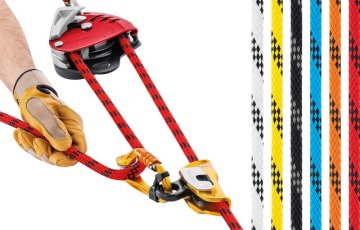
Ultimate Guide to Petzl Work Ropes: Technologies, Benefits, and Model Comparison
Whether you work at height, are involved in rescue operations, or have a passion for tree care (arboriculture), a work rope is literally your lifeline. The French brand Petzl has been at the absolute forefront of vertical equipment development for decades. Their ropes are synonymous with reliability, innovation, and a long lifespan.
But how do you choose the right one? In this article, we will look at the key technologies of Petzl ropes and detail the most popular models to make your choice easier.
History and Innovations: Why Choose Petzl?
The Petzl brand has its roots in caving, where founder Fernand Petzl began innovating equipment for safe rope progression in the mid-20th century. From the underground, the technologies quickly moved to rope access technicians and rescuers. Today, Petzl sets the trends.
Among the greatest advantages of their work ropes (static or low-stretch kernmantel ropes) is their consistent performance due to specific construction and patented technologies:
- EverFlex Technology: This is a true game-changer. It ensures the rope maintains excellent flexibility and great handling (knotability) over a long period, regardless of the conditions (water, dust, mud). The rope does not stiffen and works perfectly with descenders and positioning devices.
- Specific Construction (Nylon and Polyester): Most Petzl ropes combine a nylon core (for strength and shock absorption) and a polyester sheath. Polyester is highly abrasion-resistant and, unlike pure polyamide, absorbs significantly less water, making it the ideal material for harsh weather conditions.
- Innovative Terminations: Petzl offers ropes with pre-sewn terminations or patented small splices, which easily pass even through the friction chains of mechanical Prusiks (e.g., ZIGZAG).
Comparison of Standard Ropes for Work at Height and Rescue
These models are designed for classic rope access, work at height, and handling heavy loads. They feature a core and sheath that minimize rope compression under load.
- AXIS 11 mm: The gold standard for work at height. The 11 mm diameter ensures a good grip and easy handling. It is the ideal "all-rounder" rope.
- PARALLEL 10.5 mm: Excels in extreme flexibility and low weight. It has the lowest static elongation under tension, which increases efficiency during rope ascents (no "rubber band" effect).
- BEAM 11.3 mm: A strong rescue rope. While maintaining a very reasonable diameter and excellent handling, it offers massive strength up to 40 kN.
- VECTOR 12.5 mm: The heavyweight rescue specialist. The large diameter provides a maximally solid grip when handling extremely heavy loads. Excellent comfort and strength (45 kN).
Technical Specifications: AXIS vs. PARALLEL vs. BEAM vs. VECTOR
| Parameter | AXIS 11 mm | PARALLEL 10.5 mm | BEAM 11.3 mm | VECTOR 12.5 mm |
| Primary Use | Work at height | Rope access | Rescue | Rescue (heavy loads) |
| Weight per meter | 82 g | 75 g | 90 g | 113 g |
| Static elongation | 3 % | 3.4 % | 2.5 % | 2.4 % |
| Total strength | - | - | 40 kN | 45 kN |
| Strength (figure-eight) | 19 kN | 15 kN | 20 kN | 25 kN |
| Impact force (factor 0.3) | 5.2 kN | 5.2 kN | 5.9 kN | 5.4 kN |
| Percentage of sheath | 41 % | 45 % | 36 % | 45 % |
| Certifications | CE EN 1891 type A | CE EN 1891 type A | EN 1891 type A, NFPA | EN 1891 type A, NFPA |
Comparison of Ropes with Spliced/Sewn Terminations (Tree Care and Special Applications)
Ropes with factory terminations significantly increase the safety and fluidity of work, as the eye is always stronger and narrower than any hand-tied knot.
- FLOW 11.8 mm: A special tree care rope made of 100% polyester. It is thinner, lighter, and thanks to the patented small splice, passes smoothly through ZIGZAG mechanical Prusiks or descenders. Low stretch increases efficiency when moving through the tree canopy.
- CONTROL 12.5 mm: The more robust brother of the FLOW model, also designed for tree care. The larger diameter (12.5 mm) ensures an excellent, firm grip. Available with one or two spliced ends.
- AXIS 11 mm (Sewn Termination): A special version of the AXIS rope with a sewn termination and a protective sheath that keeps the connector in position. It is specifically designed for use with ASAP and ASAP LOCK mobile fall arresters (meets the EN 12841 standard for fall protection).
Technical Specifications: FLOW vs. CONTROL vs. AXIS with Sewn Termination
| Parameter | FLOW 11.8 mm | CONTROL 12.5 mm | AXIS 11 mm (Sewn Eye) |
| Primary Use | Tree care | Tree care | Fall arrest (ASAP) |
| Termination | Splice | Splice (1 or 2) | Sewn termination with cover |
| Material | 100% Polyester | 100% Polyester | Polyester (sheath), Nylon (core) |
| Weight per meter | 102 g | 115 g | 82 g |
| Static elongation | 2.8 % | 3.1 % | 3 % |
| Strength (with term.) | 15 kN | 19 kN | 22 kN |
| Impact force (factor 0.3) | 5.2 kN | 5.2 kN | 5.2 kN |
So, How to Choose Correctly?
When choosing a Petzl rope, primarily consider what devices you will use on it and what weight you will be moving. For classic work at height, the universal AXIS is a safe bet. If you are looking for low weight for long rope ascents, choose the PARALLEL. Rescuers will appreciate the high strength and load capacity of the VECTOR and BEAM models. For arborists, the FLOW and CONTROL models, with their ingeniously designed splices, are an absolute necessity.