

How to Choose Crampons? A Guide to Binding Systems and Terrain.
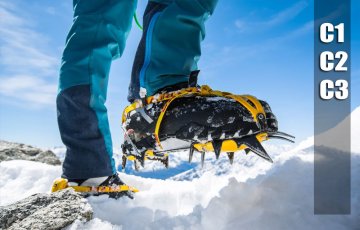
Winter in the mountains has an indescribable magic. Whether you are planning a snowy high-altitude hike, a glacier tour, or are drawn to steep ice walls, you can't do it without the right equipment. One of the most important elements is crampons. However, choosing the right model can seem like a science. Which ones will fit my boots? Which ones do I need for my activities?
Don't despair. We have prepared a comprehensive guide for you that will help you navigate the binding systems and categories of crampons according to their intended use.
The Key to Your Choice is Your Footwear: Binding Systems
The first and most important step in choosing crampons is to look at your boots. The type of footwear defines which binding system you can use. A poorly matched crampon and boot is not only uncomfortable but, above all, dangerous.
1. Strap-on Bindings (for classic hiking boots) - C1
This system is the most universal. The crampons are attached to the boot using plastic "baskets" at the front and back, which are tightened with straps.
- Suitable for footwear: Sturdy hiking boots without special welts (grooves) on the toe and heel.
- Advantages: You can use them on a wide range of sturdy boots.
- Disadvantages: Putting them on is slower, and the connection to the boot is not as firm and precise as with other systems. They are ideal for hiking, not for technical climbing.
- Manufacturers label this type as follows: Grivel "New Classic Evo", Edelrid "Soft", Singing Rock "Classic", Petzl "Flex-Lock", Black Diamond "Strap", CAMP "Universal"
2. Semi-automatic Bindings (for boots with a heel welt) - C2
This is a compromise between the strap-on and automatic systems. At the front, there is a plastic basket like on strap-on bindings, but at the back, the crampon is secured with a lever mechanism onto the heel welt of the boot.
- Suitable for footwear: Technical boots that have a rigid welt at the back but not at the front.
- Advantages: Faster and significantly more secure attachment than with strap-on crampons. They offer enough security for more demanding hikes and light alpinism.
- Disadvantages: They require a specific type of boot.
- Manufacturers label this type as follows: Grivel "New Matic Evo", Black Diamond "Clip", Singing Rock "Semi-Classic", Petzl "Lever-Lock Universel", CAMP "Semi-Automatic", Edelrid "AUTO" (with an interchangeable front piece)
3. Automatic Bindings (for boots with toe and heel welts) - C3
The firmest and most precise system, designed for technical footwear. At the front, the crampon attaches to the toe welt with a metal bail, and at the back, it is secured with a lever mechanism onto the heel welt.
- Suitable for footwear: Rigid, fully compatible boots with welts at both the front and back.
- Advantages: An absolutely firm and secure connection with the boot, quick to put on and take off. A necessity for technical climbing.
- Disadvantages: They require the most specialized (and most expensive) footwear.
- Manufacturers label this type as follows: Grivel "Cramp-O-Matic", Black Diamond "PRO", Singing Rock "TECH", Edelrid "AUTO", CAMP "Automatic", Petzl "Lever-Lock FIL"
Special Case: Ski Mountaineering Boots
Most modern ski mountaineering boots have welts at the front and back, so they are primarily designed for automatic bindings. Some manufacturers also offer special models optimized for ski boots, such as the Grivel Ski-Matic.
Crampons by Terrain and Activity
Once you know which binding you need for your boots, it's time to focus on where and how you will use the crampons.
Hiking Crampons
Designed for high-altitude hiking, glacier travel, and less steep snow slopes. They typically have 10-12 points, and the front points are horizontal, which provides better stability when walking.
-
Model examples: Petzl IRVIS and VASAK, Singing Rock FAKIR, Edelrid SHARK, Grivel G1, G10, G12 AIR-TECH, Black Diamond CONTACT and SERAC, CAMP STALKER and ASCENT.
Technical Mountaineering Crampons
For more serious mountain adventures, classic alpinism, climbing steeper snow couloirs, and mixed climbing. They are stiffer, have 12-14 more aggressive points, and the front points are often vertical for a better "bite" into the ice.
-
Model examples: Petzl SARKEN and LYNX, Singing Rock LUCIFER, Edelrid BEAST and NEMO, CAMP XLC NANOTECH and ALPINIST PRO, Black Diamond SABRETOOTH.
Ice and Dry Tooling Crampons
The top of the range for the most demanding vertical disciplines. They are extremely rigid, modular (allowing for a single - monopoint, or dual front point configuration), and designed for maximum precision on steep ice and rock.
-
Model examples: Grivel G14, G20 PLUS, G22 PLUS, and RAMBO 4, Petzl LYNX and DART, Edelrid BEAST and DEMON, Singing Rock LUCIFER TECH, CAMP BLADE RUNNER and ALPINIST TECH, Black Diamond Snaggletooth Pro.
Ski Mountaineering and Ultralight Crampons
A modern and increasingly popular category. For ski mountaineering and "fast & light" ascents, low weight is key. These crampons are often made of aluminum alloys, making them extremely light. Their disadvantage is lower durability, and they are intended exclusively for snow and firn, not for mixed terrain or rocks.
-
Model examples: CAMP (Skimo series), Petzl (Leopard series), Grivel (G-Rider series).
Conclusion
Choosing the right crampons is a crucial step for safety and enjoyment in the winter mountains. Remember a simple rule: first the boot, then the crampon. Always make sure that your chosen model is fully compatible with your footwear. Consider the terrain where you will most often be, and choose the category that best matches your ambitions. With well-chosen crampons on your feet, every step will become more secure, and you can fully enjoy the beauty of the frozen landscape. The mountains are calling!
Explore the offerings from top brands:
- Explore Grivel crampons
- Explore Petzl crampons
- Explore Singing Rock crampons
- Explore Edelrid crampons
- Explore CAMP crampons